
Guillaume Poncelet: Bringing Sea Squirt Science into Real-World Bioglues
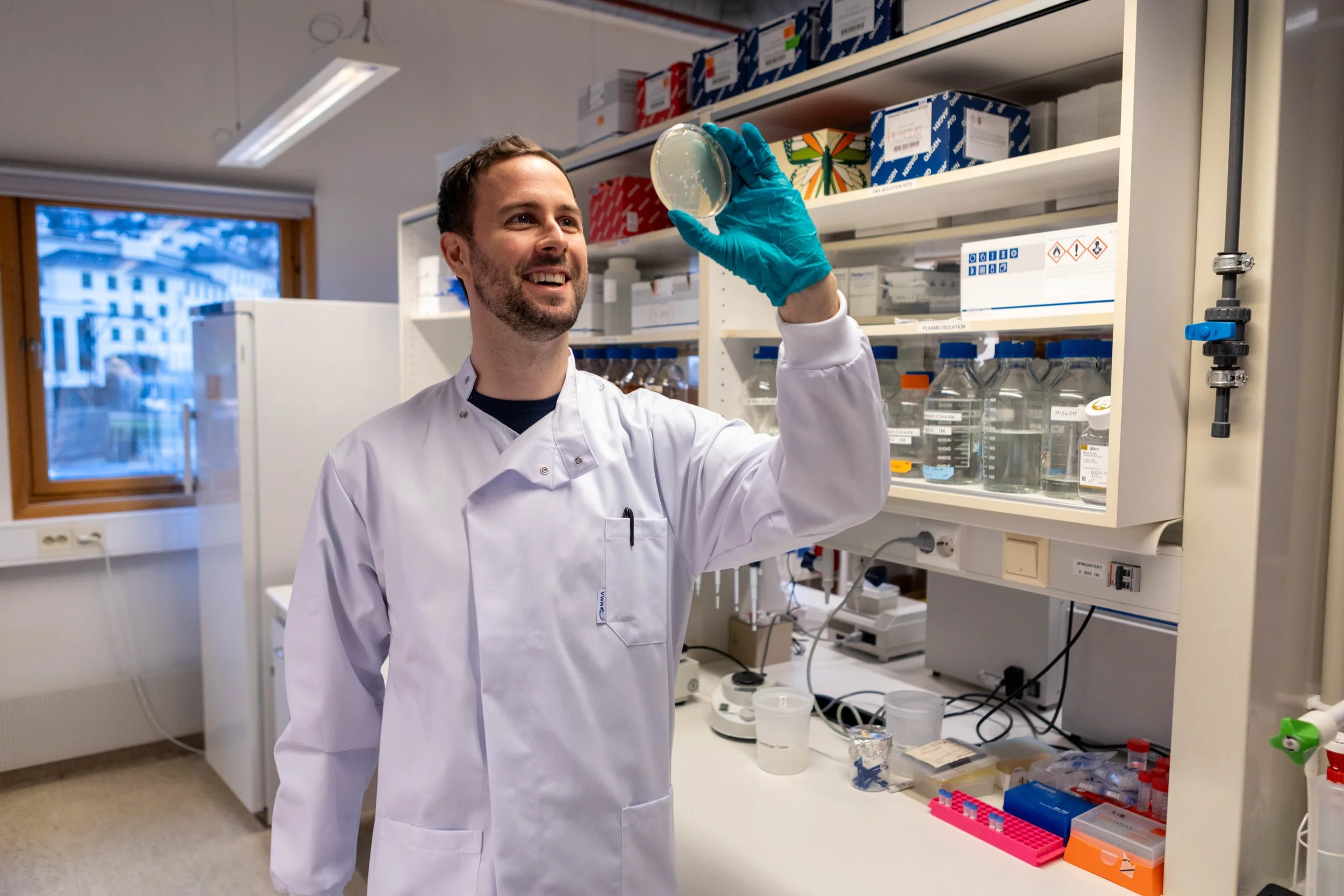
Guillaume Poncelet, postdoctoral researcher at the Michael Sars Centre, studying tunicates and marine-inspired biomaterials. Photo: Marion Lebouvier/Michael Sars Centre, UiB
Some of the most promising innovations begin far from the marketplace — in the deep curiosity of fundamental research. For developmental biologist Guillaume Poncelet, that curiosity lives inside the earliest stages of life: tiny sea squirt embryos forming a heart. But alongside his work as a postdoctoral researcher at the Michael Sars Centre in Bergen, Poncelet has long been drawn to a different question: how can the biology of the ocean be translated into tools, materials, and solutions that the world actually needs?
That question is now at the heart of his TILT Forsker project, Anchora — a tunicate-inspired marine bioglue platform designed to work reliably in wet environments, where many existing adhesives fail.
From embryonic hearts to blue biotech
Poncelet describes himself as a scientist rooted in discovery, but always with one eye on application. His research focuses on how sea squirt embryos develop a heart, a fundamental biological process that helps researchers understand how organs build themselves.
Yet he’s quick to point out that fundamental biology doesn’t have to stay fundamental.
«Despite this very basic type of research, I’ve always had a strong interest in blue biotech — and in turning biology into practical materials and tools.»
It’s precisely this bridge between biology and utility that Anchora aims to build: taking inspiration from a marine organism and transforming it into something that can support medical, aquaculture, and research environments.
A challenge that affects medicine, research and the sea
The problem Anchora addresses is surprisingly widespread: gluing in wet environments is hard. And while that may sound simple, it’s a major limitation across multiple industries.
In the clinic, surgeons still struggle with adhesives that don’t seal properly on wet tissue, are difficult to handle, or fail under real physiological conditions. Even small leaks or weak adhesion can complicate healing and patient outcomes.
In research and aquaculture, the situation is similar: attaching fragile biological samples underwater often requires improvised workarounds rather than solutions designed specifically for wet conditions.
The result is a gap between what’s needed and what’s available.
– Existing solutions can be toxic, hard to control, or simply not sticky enough under water. This limits both patient outcomes and experimental possibilities, Guillaume says.
Anchora: Inspired by sea squirts and built for real-world use
Sea squirts (tunicates) survive in dynamic marine environments by doing something remarkably well: they attach and stay attached. They naturally settle and stick to underwater surfaces using chemistry evolved specifically for seawater. A wet, salty, challenging adhesive environment.
Anchora is working to replicate and optimize these properties into a scalable bioglue system.
The project aims to develop a tunicate-inspired, wet-curing adhesive platform, with multiple formulations tailored to different applications; from lab research and aquaculture, to longer-term medical possibilities.
«Anchora is based on the unique chemistry of sea squirts and aims to recreate and optimize these wet-curing properties in a scalable system.»
The ambition is not only to make an adhesive that works underwater — but to develop a material platform with potential to evolve into a whole class of sea-derived adhesive solutions.
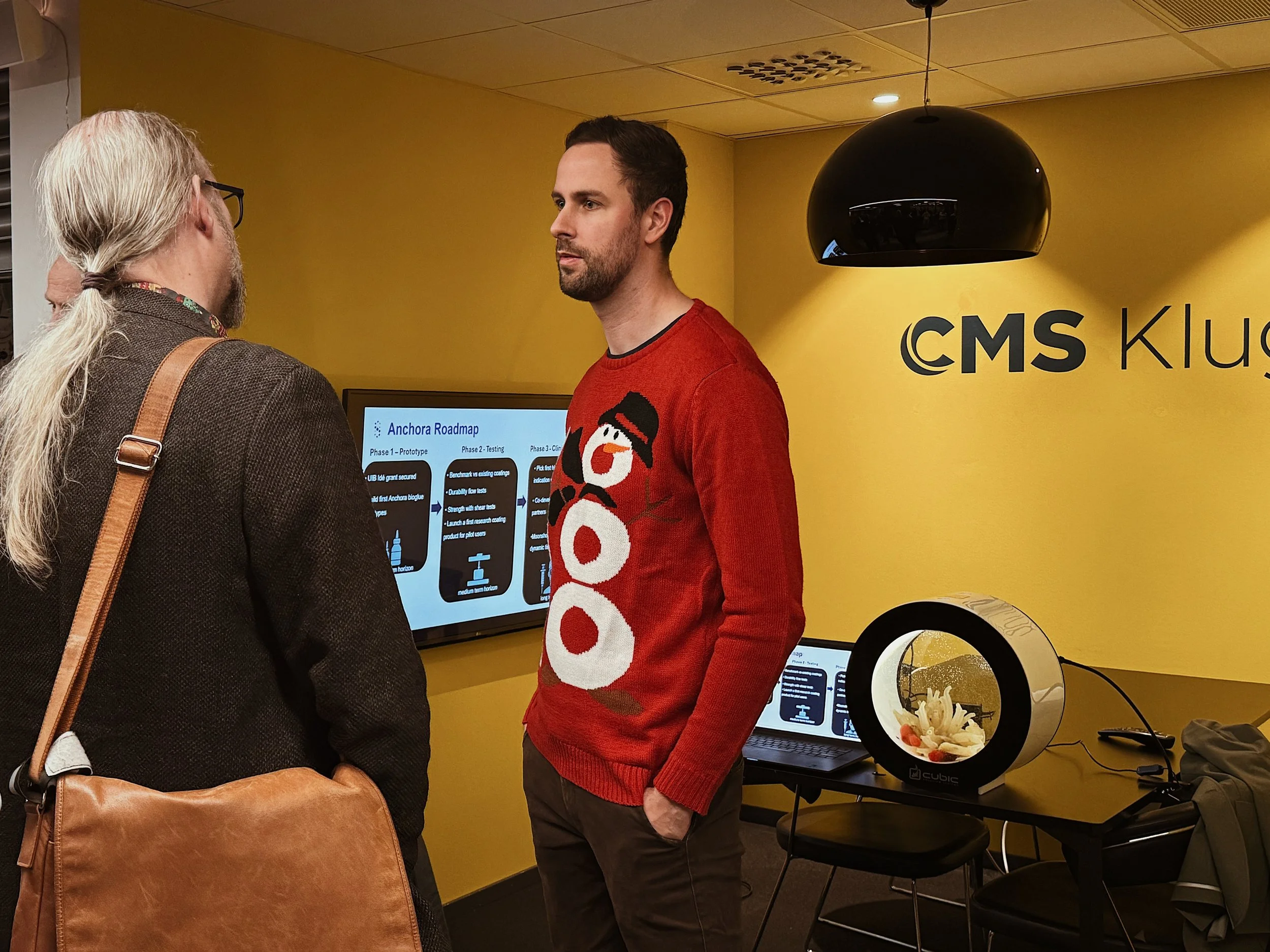
Guillaume Poncelet at TILT Researcher Christmas Pitch, showcasing Anchora and its tunicate-inspired bioglue concept. Photo: Martine Turkevyč Tangenes/VIS
Why TILT and why now
Guillaume joined the TILT Researcher program because he wants Anchora to become more than a promising side project.
«I don’t just want Anchora to stay an interesting idea. I want to learn how to turn it into a real company.»
For him, the value of TILT lies in structure — and in access to something researchers often lack inside academic institutions: commercialization mentorship, market testing, and a network that understands early-stage innovation.
He describes TILT as a way to pressure-test the idea, sharpen the value proposition, and move from scientific potential to a clearer understanding of customer needs.
From research project to startup platform
The long-term goal is ambitious but clear: to build a startup that introduces a new class of wet-curing bioglues for research, aquaculture, and medical use.
But Guillaume is thinking beyond a single product.
In the longer term, he hopes Anchora could become a small platform for marine-derived adhesive materials — developed together with surgeons, scientists, and industrial partners.
– I’d like Anchora to become a platform where we co-develop solutions with surgeons, scientists, and industrial partners, he says.
Personally, the project represents something equally significant: a path from academic research into entrepreneurship, and into the founder role.
Momentum and a new way to look at a model organism
Right now, what excites him most is that Anchora is beginning to feel real.
With support from UiB and VIS through TILT, and funding from the UiB idea grant, the project is moving toward early prototyping, potentially including a first medically oriented prototype for lab testing.
– It suddenly feels realistic that Anchora can move from an idea on paper to a first medically oriented prototype that we can test in the lab.
And there’s a deeper excitement too: showing that a model organism used mainly for fundamental research can also inspire applied innovation.
– I’m excited to take a model organism usually seen only as a research tool, and show that it can also inspire very concrete, applied solutions, Guillaume adds.